About
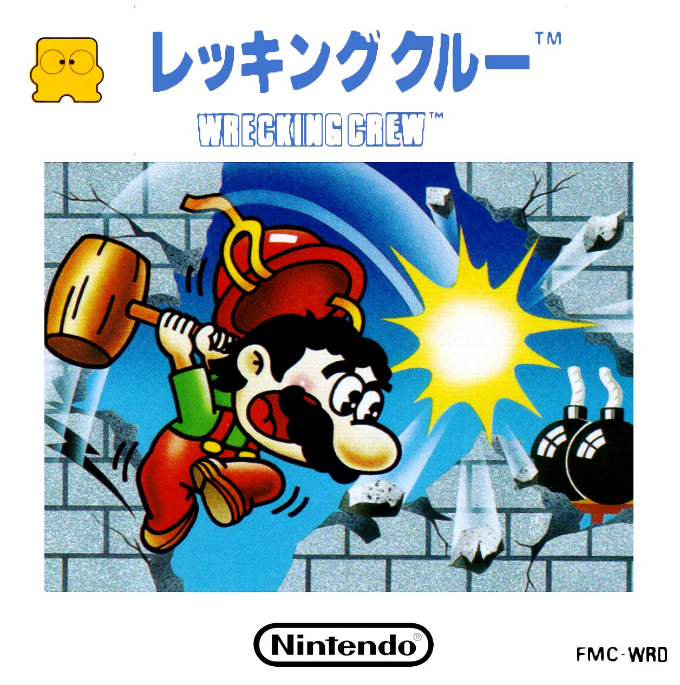
Wrecking Crew for the Family Computer Disk System is Nintendo’s construction-site action puzzle game starring Mario, reissued in Japan for the disk-based Famicom add-on on February 3, 1989. Nintendo developed and published the game, which had first appeared for Famicom in 1985 after an earlier VS. System arcade version. This FDS release preserves the compact, single-screen design that sets it apart from Mario’s running-and-jumping adventures: Mario is a demolition worker carrying a hammer, and finishing a stage means planning how to take its structures apart.
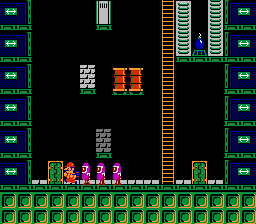
Each of the 100 built-in stages is a fixed arrangement of breakable walls, pillars, ladders and other objects. Mario can move left and right, climb, and swing his hammer, but the tool is the key limitation as well as the key ability: he cannot jump while carrying it. A seemingly simple task of clearing every required object therefore becomes a route-planning problem. Removing a ladder can close off an upper platform, while smashing the wrong wall too early can leave an essential target unreachable. Players can begin from any listed phase, making it practical to return to difficult layouts rather than replaying a long uninterrupted campaign.
The construction site is hazardous even before its puzzle structure is considered. Indestructible barrels and ladders shape safe paths, while roaming enemies, fireballs and the disruptive Foreman Spike complicate a demolition plan. Spike, called Blackie in the Japanese release, can knock down parts of the structure and send Mario tumbling. Doors offer a tactical response by allowing enemies to pass into the background. Bombs are the most dramatic tool: striking one can set off a chain that clears connected breakable objects, rewards careful placement, and can transform a crowded level in an instant.
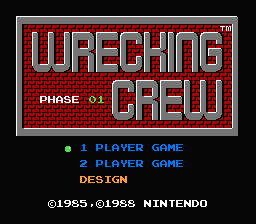
Wrecking Crew also accommodates two players, with Luigi joining Mario, and includes a design mode that lets players arrange their own obstacle courses. The editor reinforces the game’s central idea: a stage is not merely a platform to cross, but a puzzle whose order of destruction determines whether it can be solved. On the Famicom Disk System release, the game’s disk format places it within Nintendo’s late-1980s Japanese Famicom library, while the underlying designs remain those of the earlier home version. Its playable layouts still demand attention to ladders, barriers, enemy routes and escape options before the first blow lands.
The game was designed by Yoshio Sakamoto and Makoto Kanoh, with Satoru Okada directing, Gunpei Yokoi producing and Hirokazu Tanaka composing the music. Those credits place Wrecking Crew among the work of Nintendo’s R&D1-era creators, though its immediate focus is a concise score-driven puzzle challenge rather than a story-heavy Mario quest. Its visual premise also introduced Foreman Spike, the hard-hatted rival associated with the construction crew. The game’s mix of recognizable Mario characters and independent puzzle rules gives it a distinct identity within Nintendo’s 8-bit catalogue.
For players exploring FDS games, Wrecking Crew remains a deliberate, stage-by-stage test of foresight. Its best moments come from recognizing how one hammer strike changes the entire board: a bomb can open a route, a demolished ladder can ruin one, and an enemy can turn a safe plan into a quick recovery exercise. Later reissues brought the game to systems including Game Boy Advance and Virtual Console services, and Wrecking Crew ’98 revisited the name in a very different competitive puzzle format. The 1989 FDS edition, however, is the classic Mario demolition game in its original single-screen form.
Gallery
Details
- Developer
- Nintendo
- Publisher
- Nintendo
- Genre
- Logic Puzzle
- Players
- 1-2
- Release Date
- February 3, 1989
- System
- FDS
/Metroid.png)
/Knight_Move.png)