About
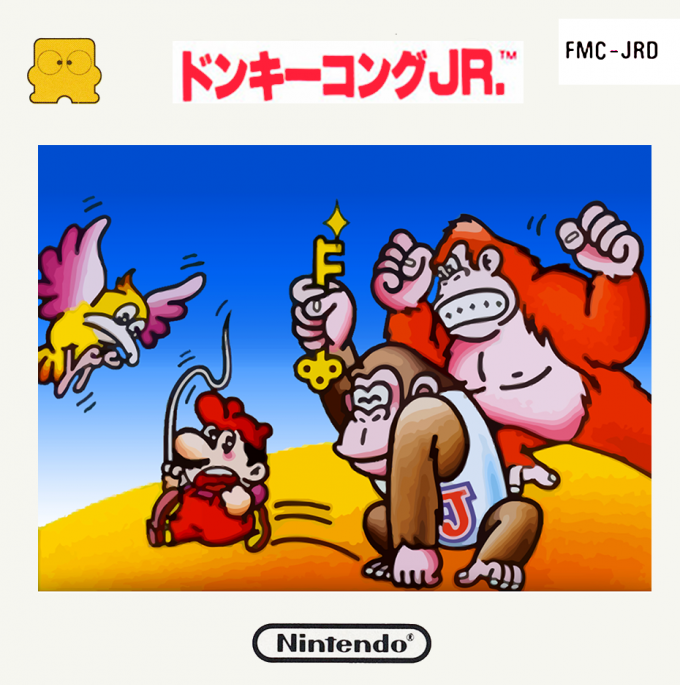
Donkey Kong Jr. for the Famicom Disk System is Nintendo’s 1988 Japanese disk release of the fixed-screen platform game that first appeared in arcades in 1982. Developed and published by Nintendo, it brings the second Donkey Kong game’s unusual role reversal to the Family Computer’s disk add-on: Mario has captured Donkey Kong, and his son, Donkey Kong Jr., must climb through a series of dangerous screens to free him. The game had previously reached Japan’s Famicom as an early cartridge release; this version was issued for the Disk System on July 19, 1988.
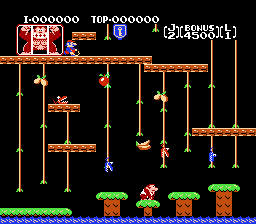
The objective is simple to state but demanding to execute. Junior begins below his father’s cage and must work upward toward keys while avoiding enemies and the steadily shrinking bonus timer. He can run along platforms, jump gaps and hazards, and grab the vines, chains, ropes, or other vertical routes that define each screen. Holding two climbing lines lets him move faster, but choosing a route also means judging where an enemy is headed and when it is safe to switch across.
The first three stages end when Junior reaches the key near the cage, causing Mario to retreat with Donkey Kong before the chase moves on. The final screen changes the goal: six keys must be pushed into their locks to release Donkey Kong. Clearing the four-stage set returns the player to the beginning at a higher difficulty, turning a rescue mission into a score-driven endurance challenge. Remaining bonus time is added to the score, while contact with enemies or projectiles, a bad fall, a plunge into water, leaving the bottom of the playfield, or running out the timer costs a life.
Each screen gives the game a distinct climbing problem. Junior faces Snapjaws, the animated trap-like pursuers that travel along climbing paths, as well as Nitpickers and other hazards in Mario’s improvised hideouts. Fruit placed above the action can be dislodged; when it falls, it can remove enemies in its path. That creates a tactical alternative to simply jumping or climbing away, especially when several hazards crowd the same route. The design asks players to balance fast ascents against the safer, sometimes slower use of alternate lines and falling fruit.
Donkey Kong Jr. is a direct continuation of the original Donkey Kong, but its perspective makes it a notable early entry in Nintendo’s character history: Mario is the obstacle between Junior and a captive Donkey Kong. Shigeru Miyamoto and Gunpei Yokoi were among its principal designers, with Miyamoto also contributing graphics and Yukio Kaneoka composing the music. The Famicom Disk System edition preserves the arcade game’s compact, repeatable four-screen structure for a Japan-only Nintendo format, making it part of the long trail of home versions that carried Donkey Kong Jr. beyond the arcade.
Gallery

Details
- Developer
- Nintendo
- Publisher
- Nintendo
- Genre
- Platformer
- Players
- 1-2
- Release Date
- July 19, 1988
- System
- FDS
/Metroid.png)
/Yume_Koujou_Doki_Doki_Panic.png)