About
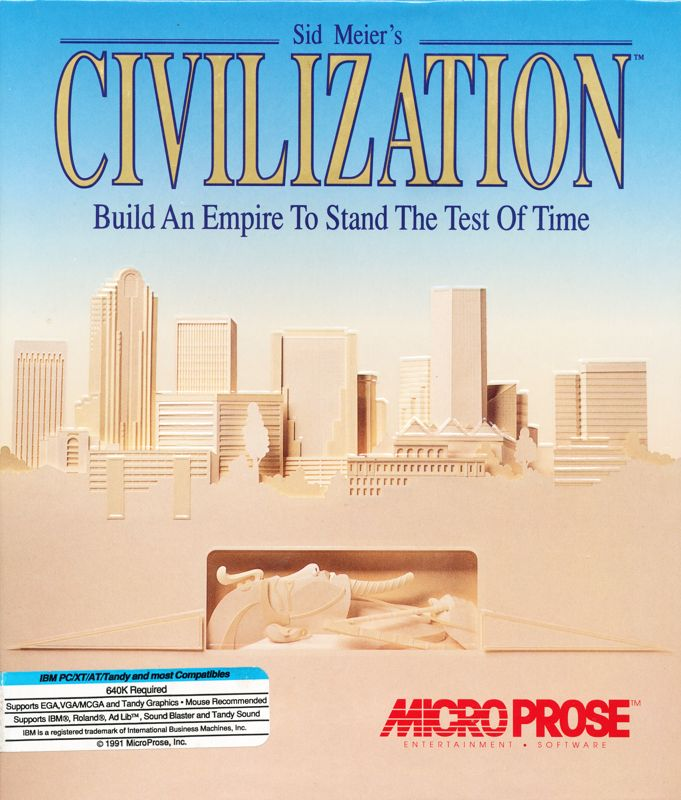
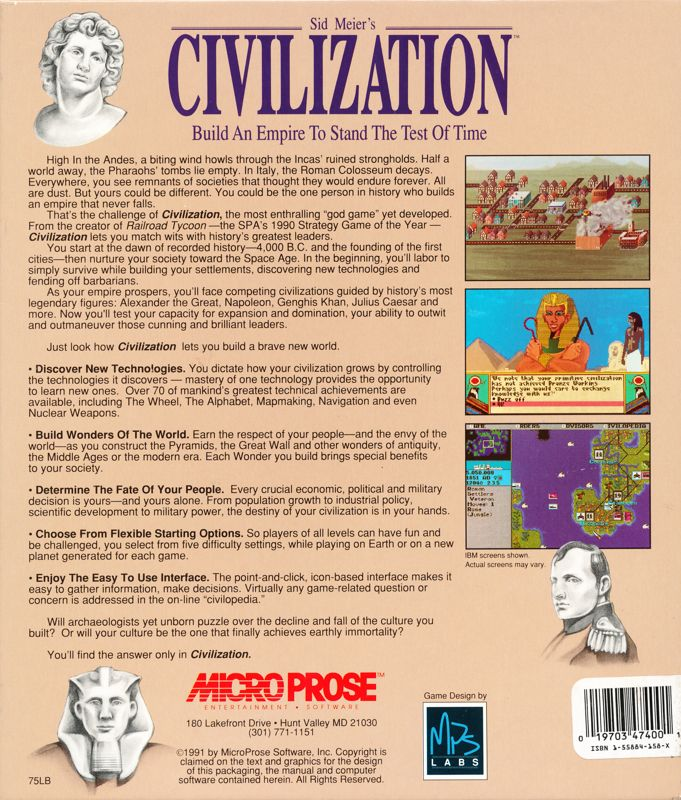
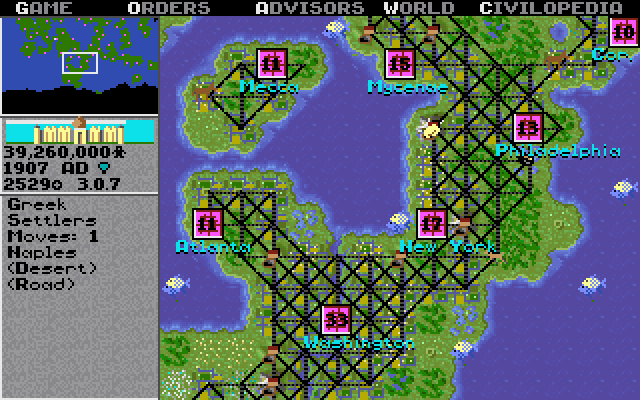
Sid Meier's Civilization for DOS is a turn-based strategy game from MicroProse in which a single settlement becomes the starting point for a civilization spanning millennia. A game begins in 4000 BC with a settler and military unit on a map of land, water, and resources. The objective is to guide that society from its earliest foundations into the modern era while competing with other civilizations.
Settlers establish cities and can reshape the nearby landscape with irrigation, mines, roads, and, later, railroads. Each city turns its worked terrain into food, production, and trade. The player directs what a city produces, choosing among buildings, Wonders of the World, civilian units, and military forces, while population growth and local improvements determine how large and productive an empire can become.
Exploration begins with the world still largely unknown. Moving units uncover coastline, terrain, special-resource squares, and tribal villages, while scouts and armies can meet rival nations or barbarians. New cities extend control across the map, but their placement, connections, defenses, and access to useful terrain all affect the wider campaign.
Scientific advances are selected one at a time from a technology tree. Early discoveries such as pottery, the wheel, and writing lead toward new city improvements, units, and further research paths; later advances reach industrial, atomic, and space-age capabilities. The science rate is set through the civilization's economic controls, which also divide trade into taxes and luxury spending.
Government changes alter the rules under which the civilization operates. The game progresses through systems including despotism, monarchy, republic, democracy, communism, and anarchy, with different effects on trade, unrest, military support, and the ability to wage war. Managing citizens and keeping cities content becomes an important counterweight to expansion as the empire grows.
Other civilizations are led by historical figures and can be approached through diplomacy. Meetings allow proposals such as peace, alliances, tribute, exchanges of knowledge, and declarations of war. Military units occupy the same world map as settlers and use their strengths, terrain, and veteran status in combat, making defense of cities, movement routes, and strategic positions central concerns.
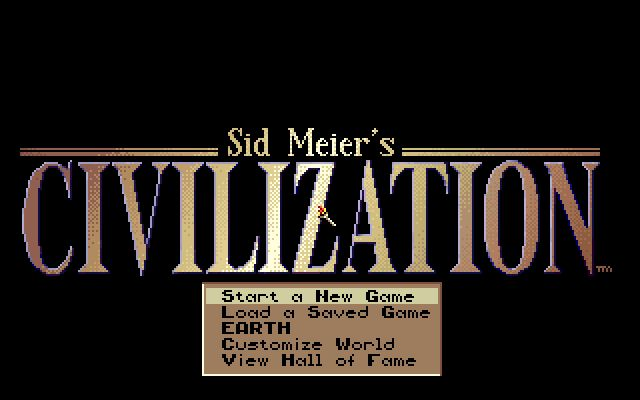
The DOS version offers randomly generated worlds as well as an Earth map option, so the geography and distribution of rivals can change from one game to the next. Its screen-based interface combines a scrolling map with menus and reports for cities, advisors, research, diplomacy, and national statistics. A civilization can win by eliminating every rival civilization or by completing the space-race path and reaching Alpha Centauri.
Designed by Sid Meier with Bruce Shelley, Civilization brought city management, technological development, diplomacy, and conquest into one long historical campaign. Its original DOS release established the basic turn structure and interconnected systems that later entries in the series would build on.
Gallery
Details
- Developer
- MPS Labs
- Publisher
- MicroProse
- Genre
- Management Simulation
- Players
- 1
- Release Date
- January 1, 1991
- System
- DOS
/Charlie_the_Duck.png)