About
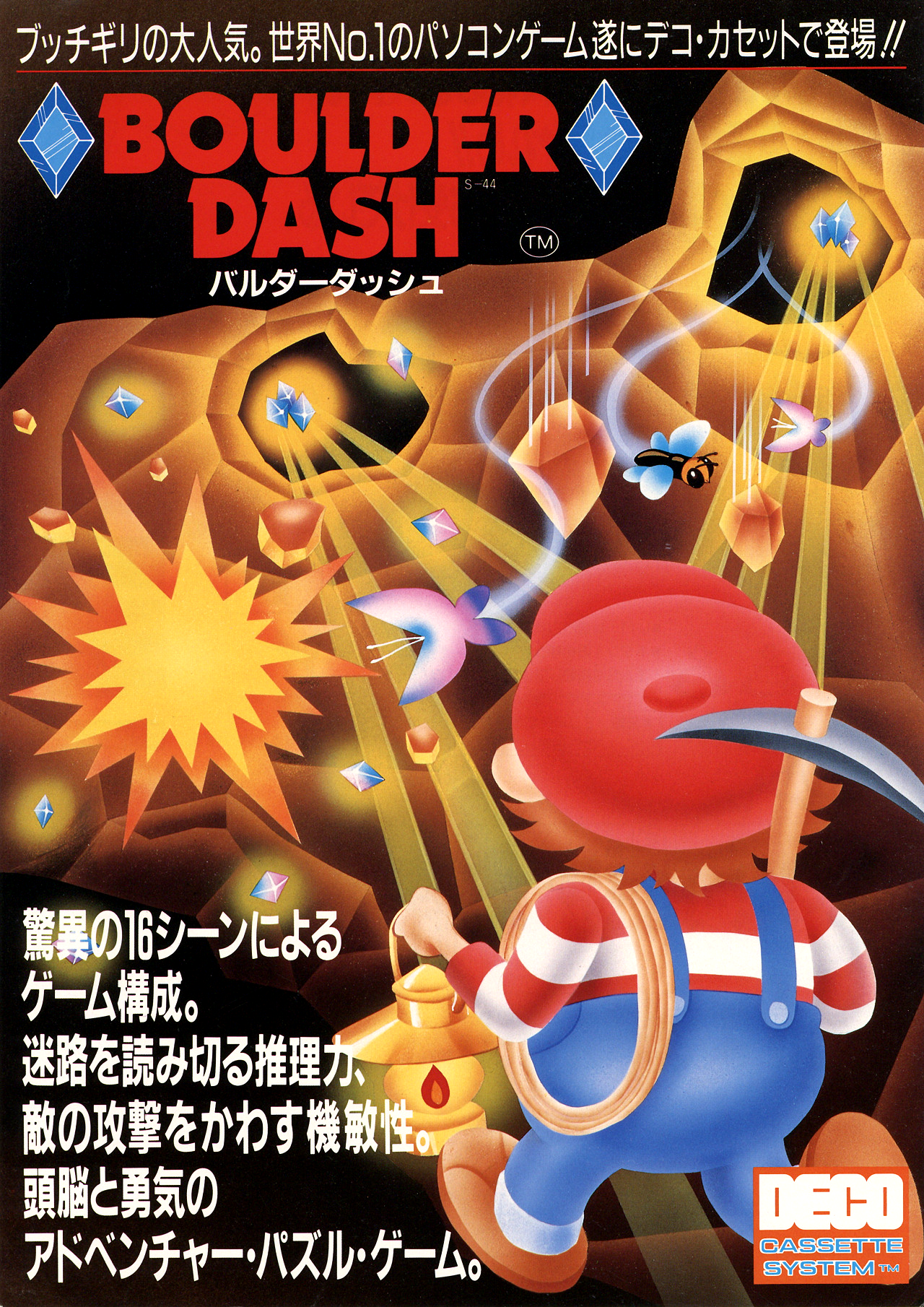
Boulder Dash for ColecoVision brings the landmark cave-exploration puzzle game to Coleco’s cartridge console. Released in the mid-1980s, this version adapts the game first created by Peter Liepa from a concept by Chris Gray and originally published by First Star Software. The ColecoVision release is commonly associated with Micro Fun and Telegames rather than the later, substantially reworked Data East arcade and NES editions. Its star is Rockford, a small miner-like adventurer whose search for diamonds turns each cave into a quick, hazardous logic problem.
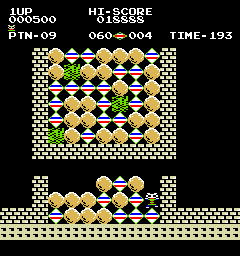
Every cave is a grid of dirt, open spaces, gems, boulders, walls, and living threats. With the ColecoVision joystick, the player moves Rockford through the soil one square at a time, clearing tunnels and gathering the required number of diamonds before the timer runs out. Reaching the quota activates the exit; finding and entering it carries Rockford to the next cave. The simple objective conceals a constant choice between taking an immediate gem and preserving a safe route through a changing maze.
Boulders provide the central rule and the central danger. They stay put while supported by earth or another object, but fall whenever the space beneath is opened. Rockford can push a boulder sideways only when there is clear room beyond it, so a single move can unblock a passage, seal it, or set up a fatal collapse. Falling rocks can also eliminate certain enemies, rewarding careful timing and an understanding of the cave’s geometry. A move that looks safe can become a trap when a shifted stone rolls into a new position or cuts off the path back to the exit.
The caves add pressure through hostile creatures and reactive obstacles. Fireflies and butterflies patrol their own patterns, while amoeba can spread through available space and change the layout if it is left unchecked. Rocks and enemies are not merely decoration: their interactions create opportunities to turn danger into diamonds, but only when Rockford is positioned safely outside the result. Later caves ask players to read the board before digging, manage shrinking time allowances, and recognize how a modest opening can trigger a chain of falling objects.
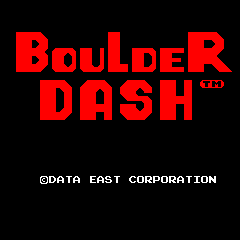
As a ColecoVision adaptation, Boulder Dash retains the compact, screen-by-screen cave format and the fundamental rules that defined the 1984 home-computer original. It should not be confused with Data East’s vertical-screen DECO Cassette arcade interpretation or the 1990 NES version, which introduced a more cartoon-like presentation, additional music, and an overworld-style progression display. The ColecoVision game instead centers on the classic balance of route planning, joystick precision, and improvisation under a countdown.
Boulder Dash helped establish the rocks-and-diamonds style of action-puzzle design: the playfield behaves like a small system whose pieces can be manipulated, rather than a maze that simply needs to be traversed. For ColecoVision players, its lasting appeal comes from that readable set of rules and the escalating ways the caves combine them. Rockford’s task is always to collect enough diamonds and escape, yet each new cave makes the route to that goal feel like a fresh mechanical puzzle.
Gallery

Details
- Developer
- Data East
- Publisher
- Data East
- Genre
- Maze, Logic Puzzle
- Release Date
- January 1, 1985
- System
- Colecovision