About
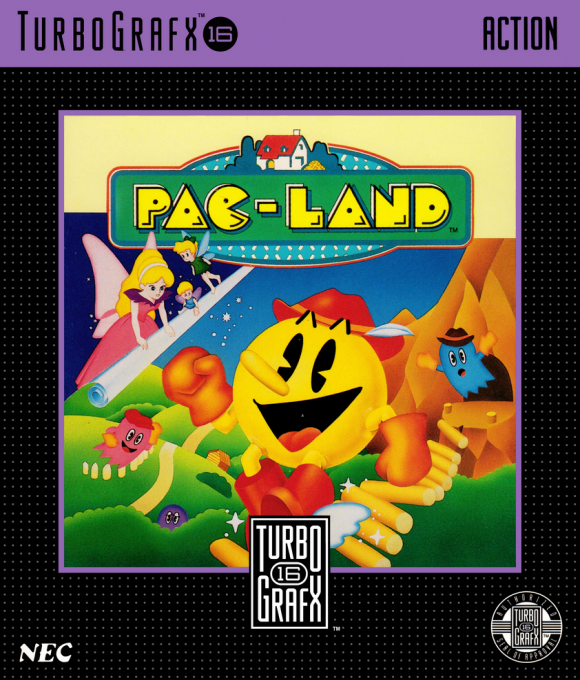
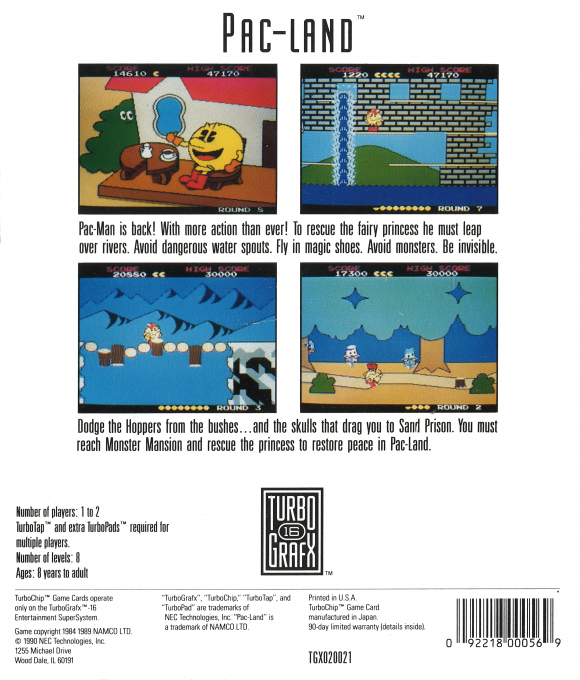
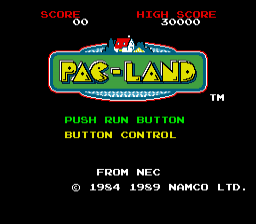
Pac-Land for PC Engine is Namco’s 1989 HuCard conversion of the 1984 arcade platform game, released in Japan as パックランド. It takes Pac-Man out of the maze and into a side-scrolling adventure: a fairy has become stranded in Pac-Land, and Pac-Man must escort her home to Fairyland before making the return trip to his own family. The game brought the character’s animated look and a more story-led premise to NEC’s PC Engine, while preserving the fast, obstacle-filled structure of the coin-operated original.
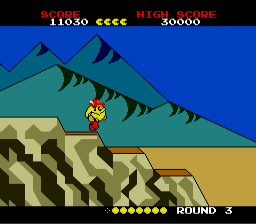
Each trip is divided into several outward sections followed by a journey home. Pac-Man automatically faces the direction in which he is moving, while separate controls let the player walk, accelerate into a run, turn around, and jump. The route scrolls through bright towns, forests, deserts, and other changing backdrops. Success depends on learning the placement and timing of hazards rather than clearing a maze: Pac-Man has to leap over pits and water, negotiate springboards, avoid falling objects, and keep moving before the timer turns a pursuing ghost into an immediate danger.
The familiar Ghost Gang remains central to Pac-Land’s challenge. Blinky, Pinky, Inky, and Clyde, joined by Sue, chase Pac-Man on foot and in an assortment of vehicles. A flashing Power Pellet temporarily turns the ghosts blue, allowing Pac-Man to reverse the chase and earn points by eating them. Fruit provides additional score opportunities, and some concealed bonuses can be uncovered by investigating the scenery. These recognizable Pac-Man ideas give the platform format its own identity: movement and jumping are as important as avoiding enemies, but the pursuit-and-power-up rhythm of the series is still intact.
Reaching the end of an outward section leads to a Break Time checkpoint and eventually delivers the fairy to Fairyland. The final portion sends Pac-Man back toward home with special boots that greatly change his jumping ability. That progression gives a complete trip a beginning, return journey, and finishing scene rather than a single uninterrupted course. As the game repeats its course structure, the hazards, enemy approaches, and pace demand more precise reactions, making route knowledge an important part of play.
The PC Engine release arrived on June 1, 1989 as a Namco-published HuCard, several months before NEC’s January 1990 TurboGrafx-16 release in North America. It is therefore distinct from the later regional edition listed under the related TurboGrafx-16 name, even though both are based on the same arcade game. This version offers control choices that accommodate the arcade-style repeated-button running method as well as an alternate setup, a useful fit for a game whose original cabinet made running a deliberate part of its design.
Pac-Land occupies an important place in Pac-Man history as the series’ first platform game. Its 1984 arcade source was designed around the contemporary Pac-Man animated television series, which helps explain Pac-Man’s expressive body, family-focused ending, and colorful travelogue setting. The PC Engine port lets players experience that early change of direction for Namco’s mascot: a game built around running, jumping, timed escapes, and familiar ghosts rather than the enclosed mazes that made Pac-Man famous.
Gallery
Details
- Developer
- Namco
- Publisher
- NEC
- Genre
- Platformer
- Players
- 1-2
- Release Date
- January 1, 1990
- System
- PC Engine
/Street_Fighter_II_Champion_Edition.png)